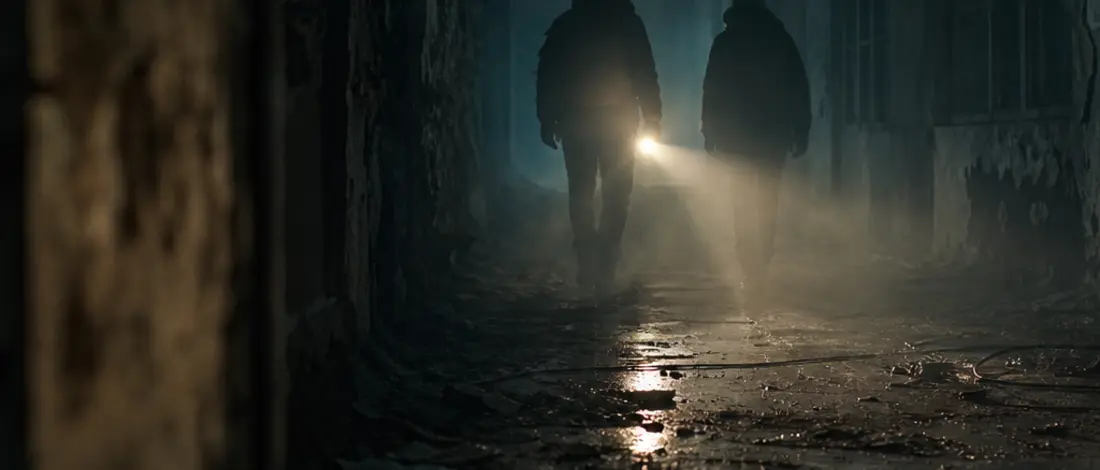
Great horror does not come from stripping action away. It comes from making action costly. The moment that lingers is rarely total helplessness; it is the instant a team sees a path forward, understands the risk, and moves anyway. In co-op design, that balance is especially potent, because dread is no longer private. It is negotiated aloud, shared through bad calls and brave ones, and sharpened by the fragile hope that someone else might still pull the plan together.
Why the Best Co-Op Horror Never Makes Players Feel Helpless
The strongest co op horror games understand a simple paradox: fear deepens when success feels possible. If failure seems predetermined, tension collapses into resignation. But when players believe they might survive, restore power, find the route, or save a teammate, every sound and delay gains weight. Vulnerability and capability are not opposites here. They are a paired emotional engine, each making the other more legible.
Co-op changes the texture of courage. A single player may feel trapped; a group feels tempted. One person volunteers to scout, another insists on conserving supplies, a third swears the threat is closer than it sounds. Confidence becomes social, borrowed and redistributed in real time. That is why memorable co op horror games do not aim for paralysis. They let people act decisively under pressure while ensuring that no decision ever feels fully safe.
Why This Tension Matters More Than Raw Difficulty
Raw difficulty is a blunt instrument. Pure weakness produces frustration because it denies authorship over the outcome; pure power fantasy dissolves horror because uncertainty disappears. The useful middle ground is contested competence. Players can do meaningful things, but never from a position of mastery. That unstable footing gives the experience suspense, psychological texture, and room for escalation.
It also creates better stories. The best anecdotes from horror sessions are not about flawless execution; they are about near misses, delayed rescues, selfish choices, panicked improvisation, and the one teammate who came back with the last battery. This matters across survival games and escape games alike. Pressure only feels dramatic when agency survives inside it. For designers, that makes tension more than a mood goal. It becomes a retention tool, because each system can generate consequences, arguments, and memorable choices instead of merely enforcing failure.
The Five Pillars of Feeling Vulnerable but Still in Control
Designers usually achieve this balance through a handful of recurring structures. Each one limits certainty without erasing decision-making, and each one becomes more effective in co-op because the burden of interpreting risk is shared, negotiated, and often contested.
- Resource scarcity: enough tools to form plans, never enough to solve every problem comfortably.
- Asymmetric information: one player knows the code, another hears movement, a third can reach the switch.
- Fragile health and recovery: damage should feel cumulative and consequential, not instantly terminal by default.
- Communication friction: noise, distance, obstruction, or stress should distort coordination just enough to create human error.
- Time pressure: timers, patrol cycles, worsening conditions, and shrinking safe windows force prioritization.
The key is legibility. Players must understand enough to make a choice, even if they cannot predict the result. Scarcity without clarity becomes random deprivation. Information gaps without readable signals become confusion. Time pressure without alternatives becomes a treadmill. In the best co op horror games, every pillar says the same thing in a different language: act now, but accept that action has a price.
Design Techniques That Turn Systems Into Dread
Dread emerges when systems ask for commitment before they offer reassurance. A scanner with limited charges, a crank that takes both hands, a door that opens slowly, a light source that reveals only fragments of a room: these are small design choices, but they force exposure. Tools become interesting not when they guarantee safety, but when they trade one kind of risk for another. That is where horror stops being decorative and becomes mechanical.
Objectives should also demand vulnerability. Restoring power, reading clues aloud, carrying key items, defending an injured ally, or splitting up for thirty seconds all transform progress into a public gamble. Good encounter design then frames decisions around cost rather than simple combat efficiency. Save resources or save time? Save a friend or protect the route out? Sound, lighting, animation, and environmental cues should signal threat early enough to provoke anticipation, not certainty. Temporary mastery can still emerge through teamwork and role specialization, but the world should keep destabilizing that comfort. That rhythm is essential to both survival games and co-op horror: brief control, then a new complication.
What Co-Op Horror Can Learn From Survival and Escape Design
From survival games, co-op horror can borrow attrition with intent. Hunger, wounds, dwindling power, degraded gear, and route planning all make preparation meaningful because they stretch consequences across time. The trick is compression. In horror, those systems must stay sharp and social rather than becoming background maintenance. Long-term pressure should inform the current scene, not bury it in chores.
From escape games, the genre can borrow clarity of purpose. Readable spaces, clue chains, and spatial logic give players a graspable objective even when the situation is frightening. Observation under stress is far more satisfying than random trial and error. The strongest blends of these traditions ask teams to interpret, route, and time their actions instead of merely avoiding a monster or merely solving a lock. Shared goals with unequal roles, reversible setbacks, and exits that are possible but never guaranteed are especially fruitful patterns for co op horror games because they keep hope alive without making success routine.
Common Mistakes That Break the Spell
Too much scarcity is one of the fastest ways to flatten drama into paralysis. If every action is punished, every route is terrible, and recovery is effectively impossible, players stop making expressive choices and start conserving themselves into boredom. On the other side, too much information removes dread just as efficiently. When threat states, enemy logic, and optimal routes are always obvious, fear gives way to routine execution.
Another common mistake is over-scripting teamwork. Co-op becomes mechanical when every problem has one correct role assignment and one correct sequence. Horror benefits from improvisation, miscommunication, and accidental heroics. Consequences should therefore be extensible rather than binary: wounds, lost tools, separated teams, changed escape routes, or corrupted objectives can keep drama alive after a mistake. Atmosphere alone cannot do this work. Strong audio and visual direction matter, but without supportive systems, even excellent presentation fades into habit. That lesson applies across escape games, survival games, and especially co op horror games that want fear to survive repeated play.
The Takeaway: Horror Works Best When Agency Feels Expensive
The core principle is simple: players should always have meaningful options, but every option should cost something. Time, safety, information, position, trust, equipment, or attention can all serve as currency. The goal is not helplessness. It is competence under contest, where success feels possible precisely because it must be earned through tradeoffs. When designers review a prototype, the useful question is not merely whether a mechanic increases difficulty. It is whether that mechanic increases both tension and decision quality.
That standard is a useful lens for any team building co-op fear. If a system only punishes, it shrinks the experience. If it only empowers, it drains the room of danger. The ideal space sits between those extremes, where players feel small in relation to the world but stronger together inside it. That is the territory coopsurvive is exploring, and it remains one of the richest promises of co op horror games: not safety, not dominance, but the hard-won feeling that survival was possible because the group made it so.