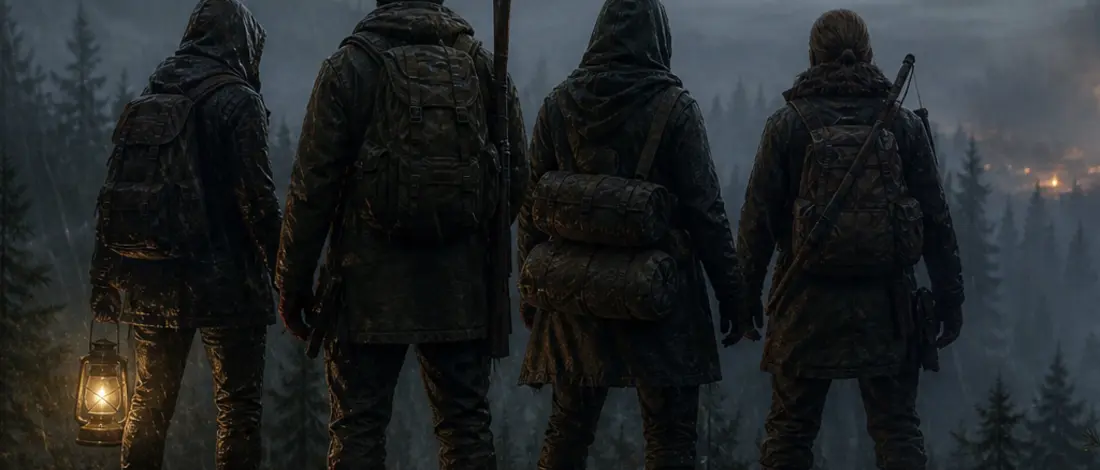
Good teamwork in survival games rarely comes from locking players into fixed roles or mandatory buddy actions. It usually comes from pressure, uncertainty, and opportunity lining up so that helping another player is the smart choice without becoming the only choice. That distinction matters for designers because players can feel the difference immediately: one version creates stories, the other creates chores.
For multiplayer co-op survival, the goal is not to script cooperation at every step. The goal is to build situations where players naturally scout, share, rescue, warn, and specialize because the world keeps rewarding coordination. Strong co-op survival game design treats teamwork as an emergent behavior, not a permanent handcuff.
Why forced cooperation often backfires
In survival games, forced cooperation usually means hard gates: two switches must be pressed at once, one player can only heal while another can only build, or a separated team simply stops functioning. These systems can produce brief moments of communication, but they also create downtime, blame, and dependency fatigue. If a partner disconnects, wanders off, or plays at a different skill level, the design stops feeling social and starts feeling brittle.
The deeper issue is agency. Players enjoy coordinating when they still feel individually capable. They resist it when the game keeps saying, in effect, wait for the other person. In a survival context, where danger already creates friction through hunger, darkness, weather, and scarce tools, adding artificial cooperation locks can overload the experience. Instead of tension, players get annoyance. Instead of problem solving, they get bottlenecks.
What real teamwork looks like in play
Real teamwork is visible when players begin making useful decisions for each other without being explicitly ordered to do so. One player draws a creature away while another grabs supplies. Someone notices storm clouds and calls the group back before the camp is exposed. A stronger fighter takes rear guard during retreat while a builder patches a shelter. None of those actions need a hard role system. They happen because the situation makes coordination valuable.
Good emergent cooperation also includes quiet, low-drama moments. Players place storage near a choke point because the team keeps passing through it. They leave crafted food for whoever returns late from scouting. They learn that carrying extra bandages is not a “medic class” duty but a team habit. This is the kind of cooperative game design that creates stories players retell later, because the teamwork came from reading the world and each other rather than obeying a locked script.
Design goals that make cooperation feel voluntary
A useful baseline is simple: every player should be able to perform the core survival loop alone, but doing it together should be safer, faster, or more efficient. A solo player should still gather wood, navigate, defend, and recover. A group should simply gain better outcomes through coordination. That preserves agency while making teamwork attractive.
Design also benefits from short-term independence and long-term interdependence. Let players split up for five minutes without the game breaking, but give them reasons to regroup through inventory limits, shared shelter benefits, map information, or time-sensitive events. Voluntary cooperation becomes stronger when each player can act decisively in the moment while still needing others over the broader arc of a session.
Another useful goal is to reward information sharing more than mechanical lock-and-key pairings. When one player spots danger, tracks an objective, or hears a distant cue, the team gains value from communication without losing the ability to improvise. That keeps cooperation flexible, which is often better suited to survival play than rigid role enforcement.
Mechanics that nudge players to cooperate organically
The best nudges are systems that create soft advantages for coordination instead of hard requirements. In practice, that means tuning multiplayer game mechanics so that players notice better outcomes when they help each other, even if they technically could continue alone.
- Complementary actions without exclusivity: any player can build a barricade, but two players finish it before the horde arrives.
- Asymmetric information: one player on higher ground can spot patrol routes or weather shifts, making communication valuable.
- Carry and transport friction: heavy loot can be moved solo, but doing so slows movement enough that escorts or shared hauling become smart.
- Noise and attention systems: mining, chopping, or repairing attracts threats, encouraging one player to work while another watches the perimeter.
- Rescue windows instead of instant failure: downed players create tense recovery choices, giving teams a chance to act rather than punishing separation with abrupt loss.
- Shared infrastructure with local benefits: campfires, workbenches, signal beacons, and storage hubs reward regrouping without forcing constant proximity.
These are strong tools for co-op survival game design because they produce decision-rich cooperation. Players ask, “Should someone escort the hauler?” or “Do we regroup before night?” That is far more interesting than asking, “Who is allowed to press the other required button?” The first creates emergent cooperation. The second creates compliance.
What survival sandboxes, co op horror games, and It Takes Two teach us
Survival sandboxes are useful examples because they often make teamwork valuable through logistics rather than strict locks. Gathering, shelter building, route planning, and defense naturally produce division of labor. Players split tasks because the environment keeps pressuring time and resources. The lesson is not “assign jobs.” The lesson is “make multiple jobs matter at once.”
Co op horror games show a different strength: fear makes information and proximity meaningful. Limited visibility, uncertain sound cues, and rescue opportunities can turn simple communication into high-stakes teamwork. But this space also shows the danger of overforcing dependence. If separation always means helplessness, tension flattens into routine caution. The best co op horror games let players risk separation for reward, then create memorable recoveries when that risk goes wrong.
The it takes two co op game is a valuable comparison because it demonstrates how strong paired mechanics can feel when they are readable, short-lived, and tightly authored. One player sets up an interaction and the other completes it; both understand their contribution immediately. The caution for survival designers is that this model works because the experience is heavily curated. In open-ended multiplayer survival, borrowing the clarity is smart, but copying constant mandatory pair gates is usually not. Use bespoke cooperation for special moments, not the entire loop.
Playtesting signs that teamwork is emerging or being forced
Playtests reveal the difference quickly if the observation goals are clear. Emerging teamwork shows up as players inventing routines the design did not explicitly assign. Forced teamwork shows up as players waiting, complaining, or asking who is “supposed” to do the required action. The key is not whether players cooperate, but whether they feel clever or constrained while doing it.
- Emerging: players voluntarily split and regroup based on risk, terrain, or resource timing.
- Emerging: they create informal roles that change by situation rather than fixed class identity.
- Emerging: communication includes warnings, planning, and tradeoffs instead of only permission requests.
- Forced: one player repeatedly stands idle because another must trigger the next action.
- Forced: failure is blamed on the system’s dependency chain more than on tactical decisions.
- Forced: players stay together only because separation disables basic play, not because regrouping is strategically better.
If testers consistently ask for ways to help each other more effectively, that is a healthy sign. If they ask for ways to avoid needing each other for basic tasks, the design is probably overconstrained.
A practical checklist for better co-op sessions
When tuning a co-op survival experience, it helps to audit every major system with one question: does this create a reason to coordinate, or does it merely create a requirement? Strong systems usually do the first.
- Keep core actions individually possible, then make cooperation improve speed, safety, or yield.
- Use information gaps, travel friction, and environmental threats to create natural teamwork moments.
- Prefer rescue, recovery, and mitigation systems over binary pass-or-fail dependency.
- Let players improvise temporary roles instead of locking them into permanent narrow functions.
- Reward regrouping through shared infrastructure and timed opportunities, not invisible leash mechanics.
- Design a few memorable set-piece cooperation moments, but avoid making every task a paired puzzle.
- During playtests, track waiting time, blame patterns, and how often players invent teamwork on their own.
If a session ends with players describing who saved the camp, who distracted the threat, and who made the risky supply run, the design is probably in a good place. That is the mark of teamwork that was invited by the world rather than forced by the rules.