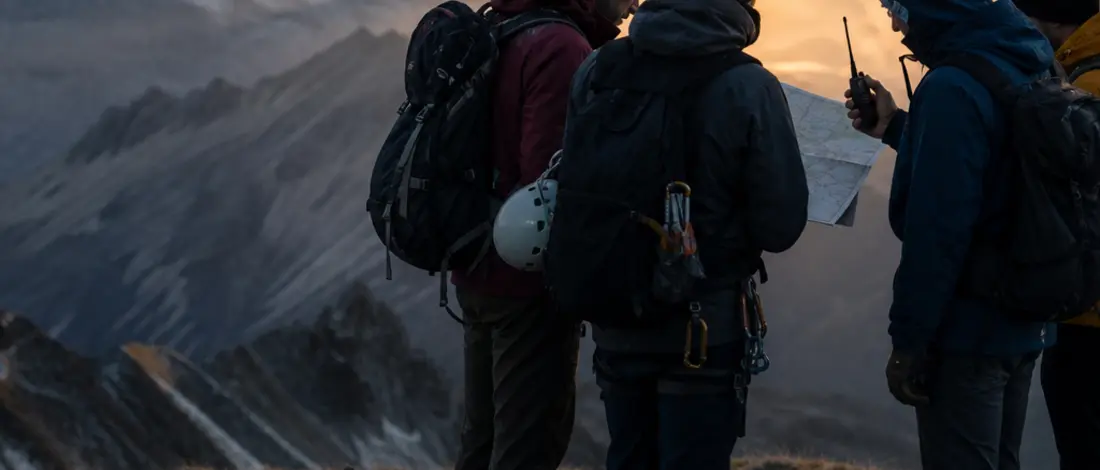
In remote terrain, bad weather, or a fast-moving emergency, team communication is not a soft skill layered on top of survival basics. It is one of the systems that keeps a group oriented, efficient, and alive when conditions start stripping away comfort and margin for error. A team that can pass clear information, confirm tasks, and surface concerns early will usually manage shelter, movement, first aid, and risk far better than a stronger group that communicates badly.
Why Team Communication Becomes a Survival Skill Under Pressure
Under field pressure, team communication stops being a matter of convenience and becomes a direct survival function. A simple misunderstanding can turn a manageable problem into a serious one: the wrong bearing gets followed, two people collect the same firewood while nobody treats water, or a hazard is noticed but never passed on to the rest of the group. In wilderness settings, those small failures stack quickly because distance, weather, and fatigue make recovery slower.
Stress distorts messages. Cold hands reduce dexterity, wind steals words, darkness narrows attention, and fatigue makes people hear what they expect rather than what was said. Injury and time pressure make that worse. Good survival team communication counters those effects by making messages deliberate, short, and confirmed instead of assumed.
Seen properly, communication is a safety system. It protects decision quality, steadies morale, and preserves cohesion when the team is wet, hungry, or uncertain. Groups that communicate well do not eliminate danger, but they reduce the number of avoidable mistakes that turn exposure, navigation trouble, or minor medical issues into a full crisis.
The Communication Framework Every Survival Team Should Use
Every field team benefits from a simple structure: state the situation, assign responsibility, confirm understanding, and report back. It sounds basic because it is meant to work in cold rain, poor light, and mental overload. Instead of speaking in broad intentions, the team speaks in tasks and confirmations: what is happening, who is doing what, and when the rest of the group should expect an update.
This is the core of closed-loop communication, and it reduces mistakes in shelter setup, fire preparation, water treatment, first aid, or route changes. If the leader says, “Mara, treat two liters now and report when it is ready,” Mara answers, “Treating two liters now, I’ll report back.” That short loop is far more reliable than, “Can someone handle water?” which invites delay, duplication, or silence.
- Better: “Tom, check that drainage line for a safe crossing and return in five minutes.”
- Better: “Leah, stop the group. Head count now.”
- Avoid: “See what’s over there.”
- Avoid: “Everybody help with camp.”
Short, unambiguous phrasing matters most when noise, panic, or low visibility are working against you. A field-ready framework keeps language practical and turns instructions into action instead of discussion.
How Roles, Check-Ins, and Shared Signals Improve Team Collaboration
Clear roles make teams faster and calmer. When one person is the navigator, another is the medic, another tracks weather and terrain, and another manages critical gear, the group wastes less effort deciding who should act. This is where strong team collaboration shows up in practical form: everyone understands their lane, but everyone also knows how their role supports the wider plan.
Regular check-ins keep the plan alive instead of letting it drift. On an expedition, that can mean a movement check every thirty minutes, a weather reassessment at breaks, a head count at each terrain transition, and a quick status review before dusk. In an emergency, the rhythm may tighten to constant updates around symptoms, route options, warming progress, or evacuation timing. These are the foundations of useful expedition communication protocols.
Shared signals matter when voices do not carry. Verbal cues, whistle blasts, hand signs, and precise map references create common understanding across brush, wind, river noise, or darkness. Teams should also treat early warnings as valuable input, not disruption. If someone notices avalanche debris, unstable footing, a missing item, confusion about direction, or signs of exhaustion, speaking up early prevents small uncertainty from hardening into a dangerous plan.
Decision-Making Patterns That Prevent Confusion in a Crisis
Confusion grows when teams blur together three separate things: who gives input, who makes the final call, and who carries out the next steps. In a crisis, those boundaries need to be explicit. A leader may gather fast observations from the medic, navigator, and nearest witnesses, then make a clear decision and assign actions. That is different from open discussion, which can be useful during planning but costly during a storm front, an injury response, or a deteriorating river crossing.
Leader-led decisions work best when time is tight and the hazard is immediate. Short group input works well when there is a brief window to compare route options, camp locations, or whether to push on or stop. What matters is that the team hears one plan, not several. Assumptions, side conversations, and competing instructions are classic crisis communication failures because they scatter attention and leave people acting from different versions of reality.
A brief after-action review during pauses can prevent repeat errors. Ask what happened, what worked, what was missed, and what changes now. These check-ins should be short and unsentimental. Their purpose is not blame; it is course correction before minor missteps become a chain of bad decisions.
Choosing Team Communication Tools for Remote and Unreliable Conditions
The best team communication tools are the ones that still function when weather turns, batteries fade, and terrain interferes. Radios are excellent for fast local coordination, especially when moving in separated elements, but they depend on battery discipline, channel control, and line-of-sight limitations. Satellite messengers can reach beyond the immediate area and support emergency contact, but they are slower for detailed exchanges and should never replace close-range coordination inside the team.
Maps, notebooks, whistles, and pre-agreed signal systems are less glamorous but often more dependable. A waterproof notebook captures bearings, timings, symptoms, and task lists when memory is degraded by cold or stress. A whistle cuts through wind better than shouting. A map marked with rally points and route changes gives the whole team a common reference instead of relying on one person’s recollection. Good survival team communication uses tools in layers, not in isolation.
Redundancy matters. Have a primary and backup for navigation, contact, and distress signaling. If the radio fails, use whistle codes and rally procedures. If digital messaging drops out, fall back to written notes, timings, and map checkpoints. Whatever the equipment, the real advantage comes from training on channels, message format, and emergency procedures before departure. Tools do not create coordination on their own; practiced use does.
Behaviors That Keep Communication Clear When People Are Tired, Cold, or Afraid
Under strain, good communication becomes behavioral before it becomes technical. Use names before instructions. Get eye contact when possible. Keep messages short, then repeat the key detail: location, timing, quantity, direction, or priority. If the information matters, have the receiver repeat it back. These habits sound simple, but they prevent many preventable mistakes in bad conditions.
Emotional control is just as important. Calm tone, active listening, and respectful correction preserve trust when the group is cold, delayed, or frustrated. Sharp sarcasm may feel harmless to the speaker, but in the field it often signals a breakdown in discipline and makes quieter members less likely to report symptoms, concerns, or doubts about the route. Psychological safety is not a luxury in outdoor risk management; it helps the team surface problems while they are still fixable.
Warning signs of breakdown are usually obvious if someone is watching: silence from normally engaged members, rushed commands without confirmation, people splitting into side conversations, or different subgroups acting from different plans. When those signs appear, pause and reset the communication pattern before continuing.
Training Communication Before the Emergency Starts
Communication needs the same rehearsal as shelter building, water treatment, and navigation. The best drills put teams into realistic conditions: night movement, limited visibility, bad weather, simulated injuries, missing gear, route changes, and forced stops. Training should include both routine coordination and higher-stress moments where the team has to pass information accurately while tired, cold, and distracted.
Pre-trip briefings should define call signs, rally points, lost-contact procedures, medical escalation thresholds, and decision rules. If the team carries radios or a satellite device, everyone should know the channels, message order, and emergency wording. If technology fails, the group should already understand whistle signals, hand signs, map references, and when to return to the last known point. These basics form practical expedition communication protocols rather than improvised habits.
The teams most likely to stay effective together are usually not the loudest or most confident. They are the ones that practice crisis communication before the crisis, and that treat communication as part of fieldcraft rather than an afterthought. When that mindset is in place, the group moves with less confusion, catches problems earlier, and gives itself a much better chance of getting everyone home.